Shivam Gaind
Résumé

Electrical Engineering/ Robotics & AI/ Controls/ Power Electronics

Shivam Gaind

M.S. Electrical Engineering at Columbia Engineering and graduate researcher in the Motor Drives & Power Electronics Laboratory. I build intelligent systems where the control loop, the power stage, and the hardware all have to work — machine testing and drives, vision and edge AI, optimization, and embedded electromechanical design.

Scroll to acquire

01 — Focus

Six domains, one habit: close the loop on real hardware.

My work sits where power, control, and computation meet. Each of these areas is backed by research, an internship, or a shipped system further down this page — not a course list.

01

Motor Drives & Power Electronics

Wound-rotor synchronous machine testing, drive-side instrumentation, and experimental validation against models at Columbia's MPLab.

Electric machinesConvertersDAQSimulink

02

Controls

Proportional control tuned on hardware, sensor placement studies, and closed-loop behaviour verified against measured response rather than simulation alone.

FeedbackGain tuningSensing

03

Robotics & Vision

Machine-vision sorting cells, IR-guided mobile robots, a field-deployed imaging trap running YOLOv8 on edge hardware, and computer vision that reads part geometry straight off engineering drawings.

YOLOv8Grad-CAMRAGDobotC#

04

Optimization

Adjoint-based electromagnetic optimization and SIMP topology optimization across coupled EM, thermal, and mechanical objectives.

AdjointSIMPCOMSOLMATLAB

05

Embedded Systems

ESP32-driven lighting, microcontroller robotics, timed edge-compute enclosures, and the wiring and power that keep them alive outdoors.

ESP32Edge computeSensors

06

Advanced Engineering & Manufacturing

Robotic dispensing, an AI shop-floor assistant and AR-assisted assembly at Northrop Grumman, satellite thermal design at Fermilab, and connector design at Wabtec.

Robotic cellsThermalProcess designNDE

02 — Selected work

Four projects worth reading in full.

Current research, a published application, a field-deployed AI instrument, and a multiphysics optimization study. Each one opens into a full case study.

01 / Current research

Motor Drives & Power Electronics Laboratory · Columbia University

Wound-Rotor Synchronous Machine Testing

Graduate research on electric machines and drives: instrumenting a wound-rotor synchronous machine, running it through defined operating points, and validating measured behaviour against MATLAB/Simulink models. The work sits across the power stage, the sensing chain, and the control side at once.

RoleGraduate Researcher
PeriodFall 2026 — Present
FocusMachines · drives · experimental validation
ToolingMATLAB / Simulink · DAQ
CurrentElectric machinesMotor drives Power electronicsControlsData acquisition
PlateOptimize App Store listing artwork Published · App Store

02 / Shipped product

iOS · iPadOS · macOS · Web

PlateOptimize

A design tool for optimized metal base plates, published on the App Store and mirrored as a web app. You give it plate dimensions, bolt layout, column geometry and loading conditions; it returns CAD-ready geometry and exports DXF, SVG and PNG straight into a manufacturing workflow.

RoleSole developer & publisher
ReleasedMarch 2026
CategoryProductivity · Age rating 4+
ExportsDXF · SVG · PNG
Live on App StoreOptimizationCAD export StreamlitDesign automation
Malaise-style insect trap deployed on a lawn, with mesh wings funnelling insects toward a backlit imaging panel Field deployment · Penn State

03 / Capstone instrument

Capstone · Computer vision · Edge AI

AI-Based Insect Detection System

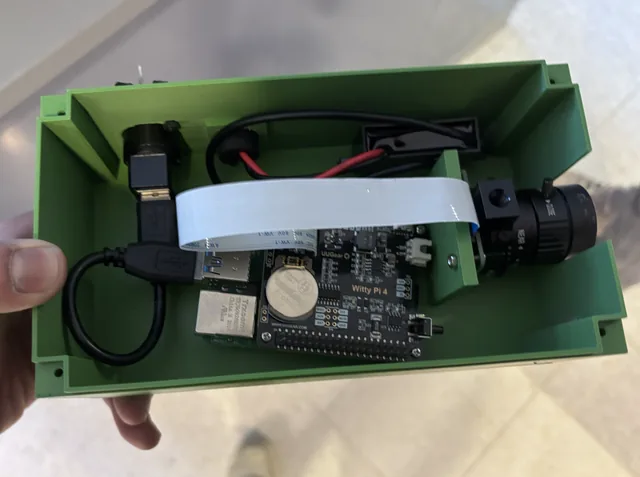
A Malaise-trap-inspired instrument that photographs insects instead of killing them. Mesh wings funnel flying insects into a photo chamber lit by ESP32-controlled LED panels; two YOLOv8 models running on an NVIDIA Jetson Nano classify what walks in by 4 orders and 10 families at close to 95% accuracy, and Grad-CAM heat maps confirm they are looking at the insect and not the background.

RoleCapstone team
PeriodJan — May 2026
PipelineTrap → chamber → imaging → YOLOv8 ×2
Result4 orders · 10 families · ~95%
Publication in progressYOLOv8Jetson Nano ESP32Grad-CAMComputer vision
Title slide reading Optimization Techniques, Shivam Gaind, Penn State Applied Research Laboratory 25-slide deck · viewable inline

04 / Research

Research Assistant · Penn State Computational Electromagnetics and Antennas Research Laboratory

Multiphysics & Topology Optimization

A study of how adjoint-sensitivity electromagnetic optimization and SIMP topology optimization combine into a single multiphysics loop — designing GRIN lenses and meta-radomes that have to raise antenna gain and survive mechanical load at the same time.

RoleResearch Assistant
PeriodJan — May 2026
MethodsAdjoint sensitivity · SIMP · FEA
StackCOMSOL · MATLAB · AWS
Topology optimizationElectromagneticsGRIN lenses Meta-radomesThermalAWS

03 — Industry & national labs

Where the work was done for someone else's schedule.

Defense manufacturing, a Department of Energy national laboratory, rail traction systems, and an applied research laboratory. Every entry links to the original documentation.

Northrop Grumman May — Jul 2025 & 2026

Manufacturing Engineering Intern

Northrop Grumman

  • Designed, built and tested a robotic dispensing system — robotic arm, pneumatic pressure regulation and solenoid-controlled actuation in one automated assembly — cutting the caulking process from 40 minutes to 7.
  • Built a Machine Shop AI Assistant: computer vision extracts part geometry from drawings and auto-generates routings across the shop's CNC mills, lathes, press brake, turret punch press and band saws, flags drawings whose tolerances exceed machine capability, and answers troubleshooting questions through a RAG chatbot trained on equipment manuals.
  • Evaluated AR headset hardware — HoloLens 2, Apple Vision Pro, Meta Quest — for manufacturing workflows, and helped implement hands-free digital work instructions.
  • Also designed an 80 lb radio antenna stand with 45° rotation in both directions, and a tool-tracking database covering checkout, return and sharpening status.
Fermilab Jun 2021 — Jun 2022

U.S. Department of Energy · Fermilab

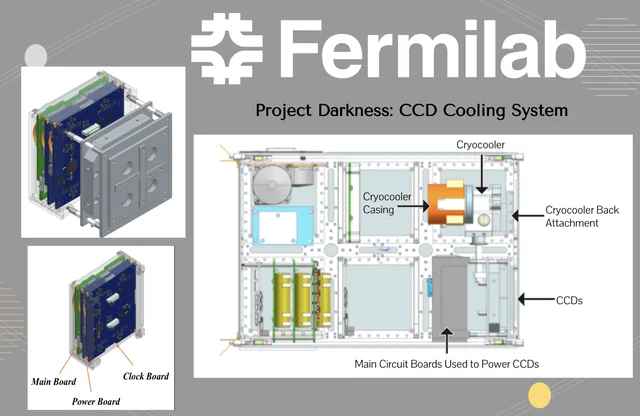
Satellite Readout-Board Cooling System

  • Designed a thermal path carrying roughly 10 W away from the three CCD read-out boards of a dark-matter X-ray detection satellite.
  • Worked the problem for vacuum: with no air, conduction and radiation to the radiator are the only mechanisms available.
  • Presented the design to mentors on the detector team as a 13-page technical report.
Wabtec May — Aug 2024

Wabtec / GE Transportation
Connector Design & Shop-Floor Tooling

  • Selected as 1 of 200 interns from a pool of 6,000+ applicants; carried a connector design through the full trade-study, design, test and validation lifecycle, ending in a cost-effective part implemented factory-wide.
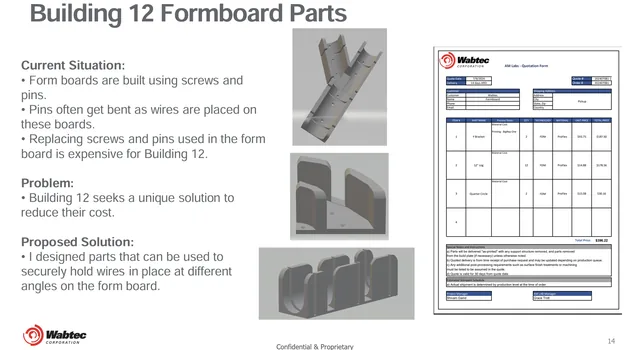
  • Developed a wire-harnessing method replacing traditional formboards with stencils.
  • Designed and 3D-printed custom connector blocks that hold varied connector sizes during wire insertion — safer for hands, and cheap enough in PLA that they stopped disappearing.
  • Built a 4× scale crimped-terminal board used at career fairs and STEM events to demonstrate wiring procedures.
Penn State Applied Research Laboratory Aug 2023 — May 2024

Penn State Applied Research Laboratory

Defect Detection in Metal Additive Manufacturing

  • Developed algorithms to identify the quantity and size of defects arising in metal-based additive manufacturing, supporting part quality verification.
  • Applied random sampling and statistical techniques to analyse defect distributions and establish a new probability model.
  • Surveyed the non-destructive inspection methods behind it — ultrasonic testing, pulsed thermography — in a 52-page review that became the reference for the sampling approach.

04 — Trace

Five years, plotted on one axis.

Education, industry and research run as three tracks against the same time base — from a national laboratory in 2021 to a Columbia power-electronics lab now.

Trace · 2021 → 2026 EDU — Education IND — Industry & labs RES — Research & projects
IND Jun 2021 — Jun 2022

Fermilab, U.S. DOE

Intern & Research Assistant

Thermal design for satellite CCD read-out boards on a dark-matter detection mission.

Experience ↓
EDU Aug 2022 — May 2026

B.S. Mechanical Engineering

The Pennsylvania State University

Foundation in mechanics, thermal systems and controls; research and capstone work layered on top.

RES Aug 2023 — May 2024

Penn State Applied Research Laboratory

Research Assistant

NDE methods and probability-of-detection statistics for defects in metal additive builds.

Experience ↓
IND May — Aug 2024

Wabtec / GE Transportation

Mechanical Engineering Intern

Stencil-based wire harnessing, printed connector blocks, and shop-floor training hardware.

Experience ↓
RES Sept 2024 — May 2025

100K Strong in the Americas

Penn State × Universidad del Norte

$3,000 grant recipient; hybrid PV–wind and water-pumping system for Puerto Mocho, Barranquilla.

Projects ↓
IND May — Aug 2025

Northrop Grumman

Manufacturing Engineering Intern

Robotic dispensing cell, antenna stand design, tool-tracking database and shop-floor AR support.

Experience ↓
RES Jan — May 2026

AI Insect Detection Capstone

Penn State

Field-deployed imaging trap; two YOLOv8 models to 4 orders and 10 families at ~95% accuracy.

Case study →
RES Jan — May 2026

Penn State CEARL

Research Assistant

Adjoint and SIMP optimization across electromagnetic, thermal and mechanical objectives.

Case study →
IND Mar 2026

PlateOptimize released

App Store · iOS, iPadOS, macOS

Base-plate design tool published, with a Streamlit web version alongside it.

Case study →
IND May — Aug 2026

Northrop Grumman

Manufacturing Engineering Intern — return

Machine Shop AI Assistant: computer vision on drawings, auto-generated CNC routings, RAG troubleshooting.

Experience ↓
EDU Fall 2026 — Dec 2027

M.S. Electrical Engineering

Columbia University · Robotics & AI

Specialising in AI engineering and signal processing / control systems at Columbia Engineering.

RES Fall 2026 — Present

MPLab, Columbia University

Graduate Researcher — Motor Drives & Power Electronics

Wound-rotor synchronous machine testing and experimental validation against Simulink models.

Case study →

2021  ·  scroll to advance the trace  ·  2026

05 — Project index

Everything else, still worth your time.

Robotics, controls, energy systems and software builds. Filter by discipline; documentation opens inline.

01

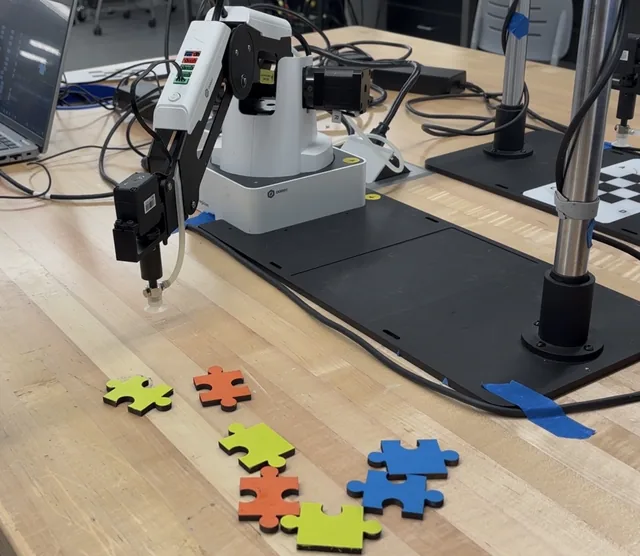
Puzzle Sorting Robot

Dobot Vision Studio and C# workflow that classifies puzzle pieces by edge status and colour, then sorts them into organised stacks.

Vision robotics · Demo video
02

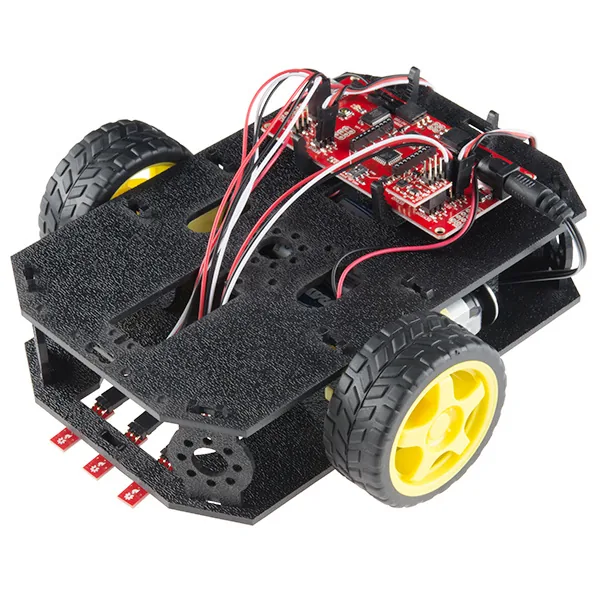
Infrared Wall-Following Robot

Proportional controller on a RedBot holding constant distance from a wall. Gain tuned by hand to Kp = 0.3 — sluggish below it, unstable above — with the IR sensor angled to see both the wall alongside and the turn ahead.

Controls · PDF
03

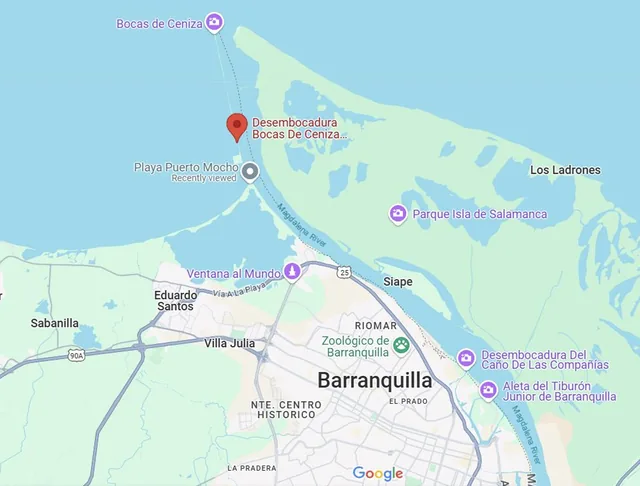
Hybrid PV–Wind & Water Pumping System — Barranquilla, Colombia

Off-grid energy and water system for the Second Beach of Puerto Mocho, designed with students from Universidad del Norte and simulated in HOMER Pro. Selected as a 100K Strong in the Americas grant recipient with $3,000 in funding; 47-page report with full energy, economic and environmental analysis.

Energy systems · PDF
04

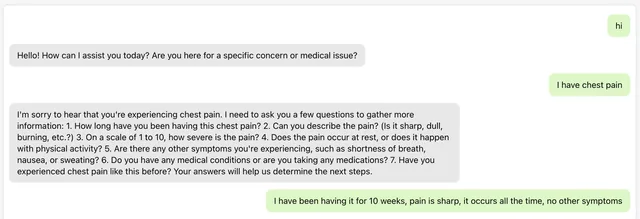
AI Chatbot for Medical Clinics

React and Node.js intake tool built on the OpenAI API that asks guided symptom follow-up questions and organises patient responses for doctors.

React · Node.js · OpenAI
05

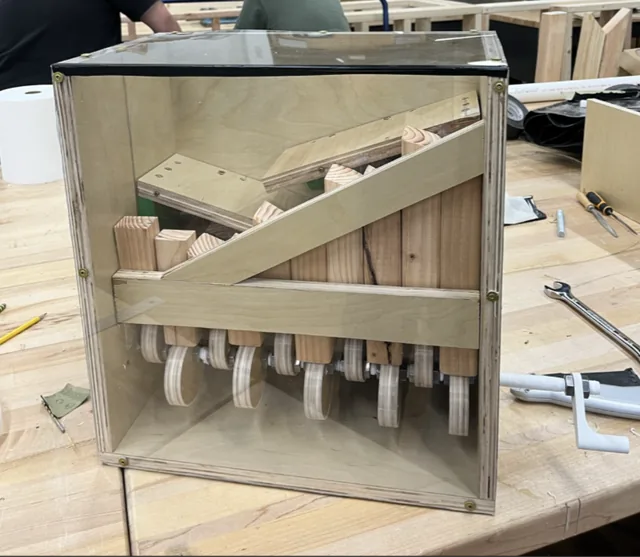
Mechanical Automata Exhibit — Children's Museum

An interactive automaton built as a museum exhibit to teach motion and linkages, designed to survive being operated by children all day.

Mechanisms · Demo video
06

Satellite Cooling System — Fermilab

Thermal path from the CCD read-out boards of a dark-matter detection satellite to its radiator, designed for a vacuum environment where convection is unavailable.

Thermal · PDF
07

Formboard Wiring & Connector Tooling — Wabtec

Stencil-based replacement for traditional formboards, plus printed connector blocks and a 4× scale terminal-board training model.

Manufacturing · PDF
08

Defect-Detection Research — Penn State ARL

Algorithms to identify the quantity and size of defects in metal additive manufacturing, with random sampling and statistical techniques used to establish a new probability model. Backed by a 52-page review of NDE methods.

NDE · Statistics · PDF
09

Engineering Mentor — Student Design Team

Guided a student team in St. Charles, Illinois through design reviews for gutter downspout repair solutions, from concept through presentation.

Sept 2024 — May 2025

06 — Contact

Open to robotics, power electronics, controls and intelligent-systems work.

Graduate researcher at Columbia, based in New York. Happy to talk about drives, embedded control, vision systems, or anything that has to survive contact with real hardware.
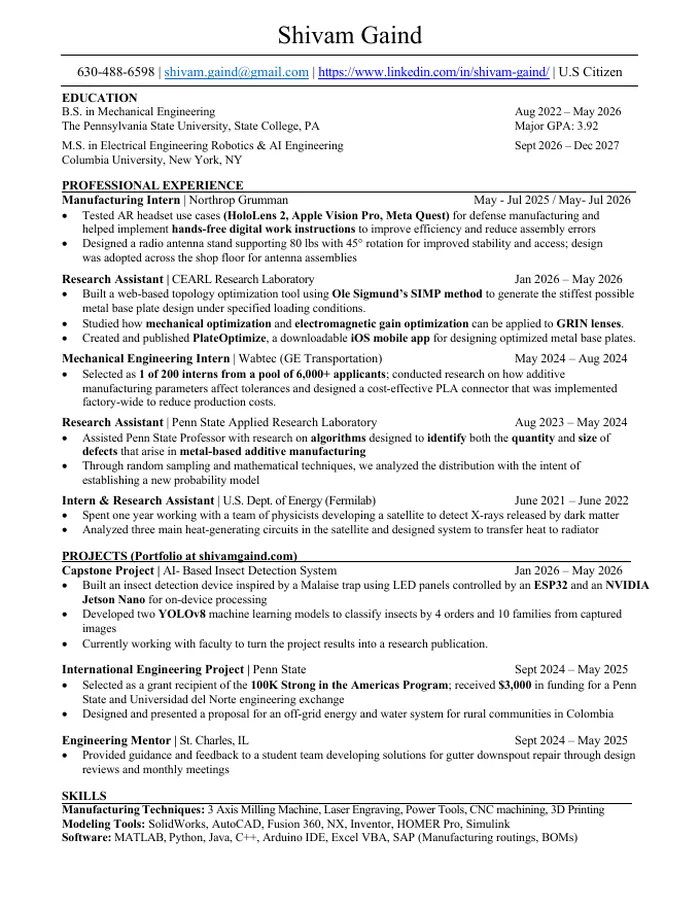
First page of Shivam Gaind's résumé

Full résumé — education, experience, projects and skills.

Download PDF